
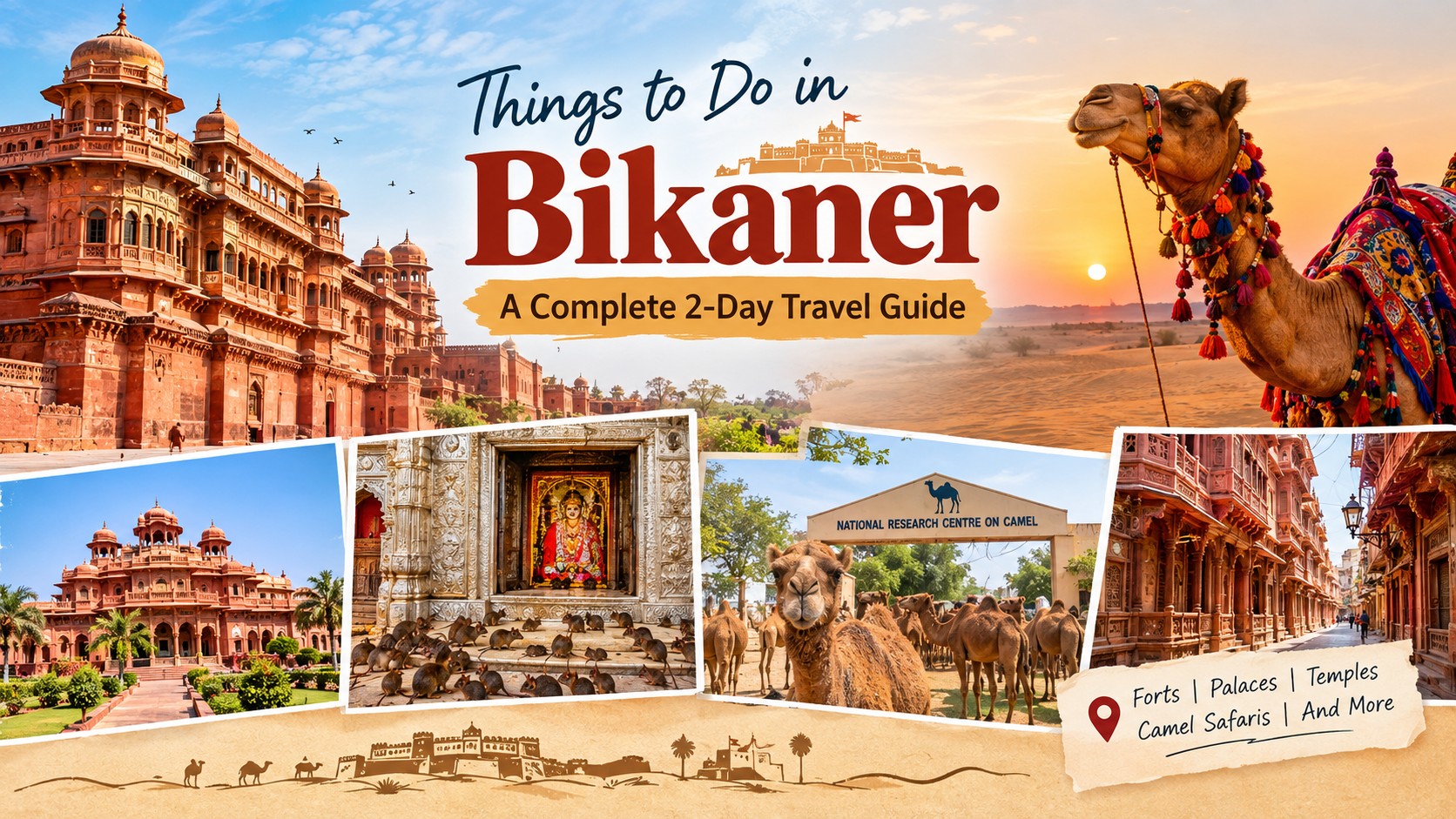
If you’re wondering what to do in Bikaner, this desert city in Rajasthan has more going for it than most people expect — a fort that was never conquered, a temple full of sacred rats, red sandstone havelis, and a camel research farm you won’t find anywhere else in India. Two days is enough to see the main sights without rushing. Here’s how to spend them, plus a few practical things worth knowing before you go.
Quick Answer: The main things to do in Bikaner are Junagarh Fort, Lalgarh Palace, the Rampuria Havelis, Karni Mata Temple in Deshnok, and the National Research Centre on Camel. Two days is usually enough — one day for the fort, palace and old city, and a second for the temple and camel farm, ending with a desert camel ride at sunset.
Day 1, Morning: Junagarh Fort
Start here. Junagarh Fort is right in the middle of Bikaner, built between 1589 and 1594, and it’s one of the few forts in Rajasthan that was never taken by force — unusual, since it sits on flat ground rather than a hilltop.
- Open 10:00 AM to 4:30 PM every day
- Entry is ₹50 for Indian visitors, ₹300 for foreign visitors (the Phool Mahal and Chandra Mahal museum section costs extra)
- About 2 km from Bikaner Junction railway station, so it’s easy to reach by auto
Give it at least an hour and a half. The Anup Mahal and the Karan Mahal inside are worth slowing down for — the painted ceilings and mirror work are some of the best-preserved in the state.
Day 1, Afternoon: Lalgarh Palace and the Rampuria Havelis
From the fort, head to Lalgarh Palace, built for Maharaja Ganga Singh in the early 1900s. Part of it is still a royal residence and part is a museum with old photographs, hunting trophies and vintage cars.
- Open 10:00 AM to 5:00 PM
- Entry fee is nominal for Indian visitors (figures vary by source — confirm current pricing before you go)
After the palace, walk through the Rampuria Havelis in the old city. These are 19th-century merchant houses with carved red sandstone fronts and jharokha balconies. There’s no entry fee, and they’re open all day since you’re just walking the lanes rather than entering a ticketed site.
Day 1, Evening: Dinner in Bikaner
Bikaner is known for Rajasthani thalis, and most hotels and restaurants in the city serve some version of it. If you’re staying at Gaj Kesri, the in-house restaurant Polki serves Rajasthani and Indian dishes alongside international options, from 7:00 AM to 10:30 PM.
Day 2, Morning: Karni Mata Temple, Deshnok
This is a half-day trip out of the city. Karni Mata Temple in Deshnok, about 30 km from Bikaner, is known as the Rat Temple — thousands of rats live inside and are fed and worshipped by visitors rather than feared. The current Mughal-style structure with its silver doors was completed in the early 1900s.
- 30 to 40 minutes by road from Bikaner
- Go in the morning, before it gets hot and before tour groups arrive
It’s an unusual stop, and one that surprises most first-time visitors more than the forts do.
Day 2, Afternoon: National Research Centre on Camel
Back in Bikaner, head to the National Research Centre on Camel, about 8 km from the city. It’s a government-run camel breeding and research farm, and the best time to visit is mid-to-late afternoon, when the camel herd returns from the desert.
- Open roughly 2:00 PM to 6:00 PM
- Entry is around ₹20–30 for Indian visitors, with a small extra charge for a camel ride
- There’s a camel milk parlour on site — the ice cream is worth trying even if it sounds unusual
Day 2, Evening: Sunset Camel Safari
End your second day the way most people remember Bikaner: on a camel, watching the sun go down over the Thar Desert. A few operators run short evening camel safaris just outside the city, and some resorts arrange this directly for guests as part of their on-site experiences — see the Recreational Experiences and Things to Do pages for what’s available if you’re staying at Gaj Kesri.
Where to Stay in Bikaner
Bikaner’s old city has smaller heritage-style guesthouses, but if you’d rather have a pool, a restaurant and event lawns on one property, resort-style stays are worth a look. Gaj Kesri, on the edge of the city, is one option worth considering — it has 45 rooms and suites, an on-site restaurant, and a pool, and it’s positioned as a base for exactly this kind of two-day sightseeing loop. You can see room details on the Stay page.
A Few Practical Tips
- Best time to visit: October to March. Summers in Bikaner are extreme, often crossing 45°C.
- Getting around: Autos and taxis are the easiest way to cover the fort, palace and old city. Karni Mata Temple and the camel centre need a car or taxi for the round trip.
- How much time you need: Two days covers the main sights comfortably. Add a third if you want a night of desert camping outside the city.
FAQs
How many days do I need in Bikaner?
Two days is enough to see Junagarh Fort, Lalgarh Palace, the old city havelis, Karni Mata Temple and the camel research centre without rushing.
Is Karni Mata Temple worth visiting if rats aren’t my thing?
Most visitors say yes — it’s less about the rats and more about seeing a working temple where thousands of them move freely, which is unlike anywhere else in India.
What is the best time of year to visit Bikaner?
October to March. The desert climate gets extremely hot from April through June.
Can I see the camel research centre and Karni Mata Temple on the same day?
It’s possible but tight, since Deshnok is 30 km away and the camel centre is best visited in the afternoon. Splitting them across two mornings and afternoons works better.
Do I need a car for two days in Bikaner?
For the fort, palace and old city, autos work fine. For Karni Mata Temple and the camel research centre, book a taxi for the day since both are outside the city.